
Home access
Ramps, thresholds and the three doorways that cause most falls
You don't need a remodel. You need about six inches of clearance in three specific places, and a way over two lips of metal.

By David Ellison
Senior mobility editor · Updated
Start with the three doorways
In most houses, mobility equipment doesn't get defeated by stairs. It gets defeated by three doorways: the front or side entry, the bathroom, and the door out to the garage. Those are the three you use every day, and they are the three most likely to be too narrow, too high at the sill, or opening the wrong way.
Measure them before you buy anything. A tape measure and ten minutes will tell you more than a week of reading spec sheets.
The five measurements to write down
- Clear door width — measure the opening with the door open 90 degrees, not the door slab. A 32 inch door often gives only 30 inches clear.
- Threshold height — the lip you have to roll over, measured from floor to the top of the sill.
- Approach space — how much straight run you have in front of the door. Under 4 feet and a chair has to turn as it enters.
- Hallway width where the chair has to turn a corner.
- Rise at the entry — total height from the ground to the door sill, in inches.
Thresholds: the cheapest fix in the house
A half-inch metal lip stops a rollator's front casters cold and jars anyone walking with a cane. A rubber or aluminum threshold ramp costs $30 to $90 and installs with adhesive or four screws. Buy one rated slightly taller than your lip, not exactly equal — you want the transition to be flat, not a small hill.
Do the sliding door to the patio too. It's usually the tallest sill in the house and it's the one that keeps people from sitting outside.
Ramps: the 1:12 rule, and when to break it
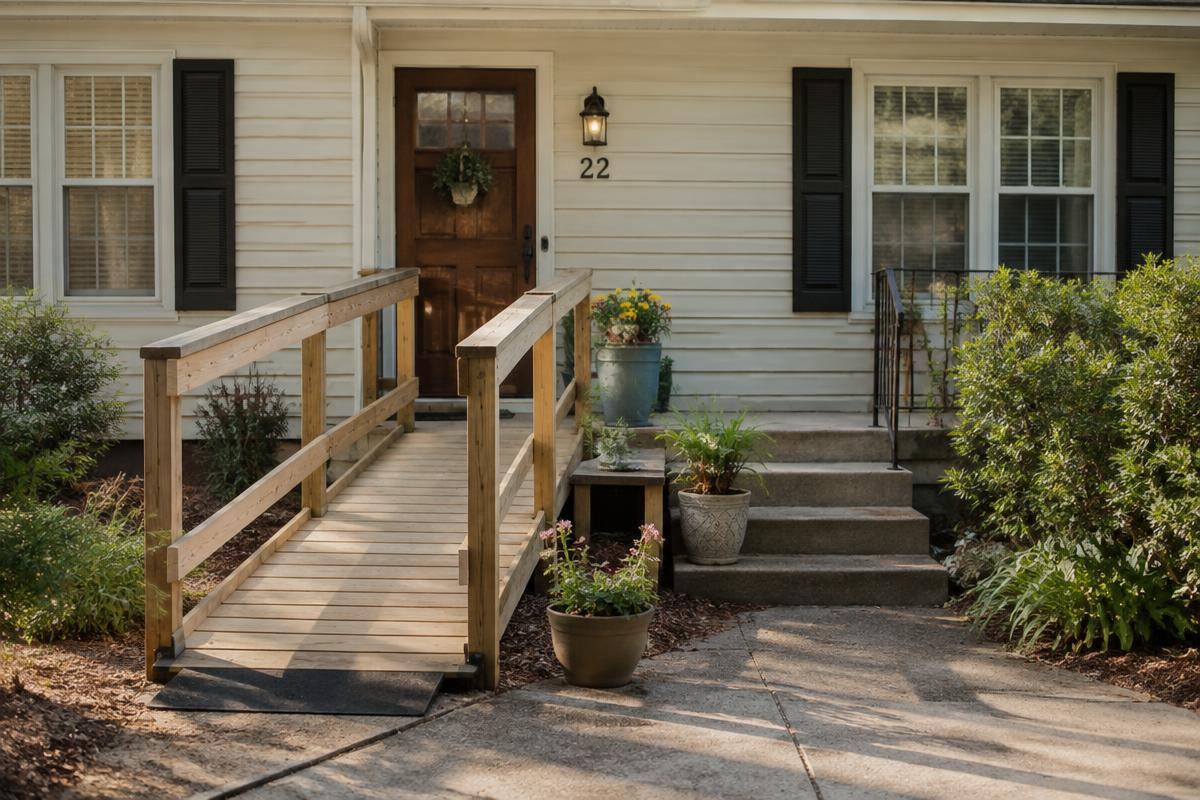
The standard for a ramp anyone pushes or drives is one foot of ramp for every inch of rise. Three steps — roughly 21 inches — means a 21 foot ramp with a landing. That surprises people, and it's why so many homemade ramps are too steep to use safely.
If you can't fit that, your options are a longer switchback with a level landing, a portable ramp for occasional use only (with someone spotting), or a vertical platform lift. Steeper than 1:8 with a power chair is how chairs tip backwards. Don't.
Widening without construction
If a door is 30 inches clear and you need 32, you may not need a contractor. Swing-clear (offset) hinges cost around $20 a pair and move the door fully out of the opening, buying roughly 1.5 to 2 inches. Removing the door stop molding buys another half inch. Taking the door off entirely and hanging a curtain buys the rest — and it's reversible.
The bathroom, honestly
The bathroom is where most serious home falls happen, and towel bars are the usual culprit — they are decorative hardware and they pull out of drywall under load. Grab bars anchored into studs or with proper toggle anchors are the single highest-value purchase in the house. Add one beside the toilet and one on the long wall of the tub or shower, at a diagonal.
A raised toilet seat, a shower chair and a handheld sprayer together cost less than $200 and change the whole room from a risk into a routine.
A weekend's worth of fixes, roughly in order of payoff
- Grab bars by the toilet and in the shower, anchored into studs.
- Threshold ramps on the entry door, garage door and patio slider.
- Swing-clear hinges on the bathroom door.
- Non-slip strips in the tub, and remove every loose throw rug in the traffic path.
- Motion-sensor night lights along the hall-to-bathroom route.
- Move daily items to between hip and shoulder height so nobody reaches or stoops.
The mistake worth avoiding
People buy the equipment first and adapt the house afterwards. Do it the other way: know your three doorway widths and your folded-height limit, then shop to those numbers. It's the difference between a chair that lives in the living room and one that lives in the garage.
This guide is general information, not a home safety inspection or medical advice. Occupational therapists do in-home assessments, often covered by insurance, and they catch things a tape measure doesn't.