
Buying guide
How much should it weigh? The honest answer, by who's doing the lifting
Weight is the single spec that decides whether mobility equipment gets used every day or moved to the back of the garage. Here's how to judge it before you buy.

By David Ellison
Senior mobility editor · Updated
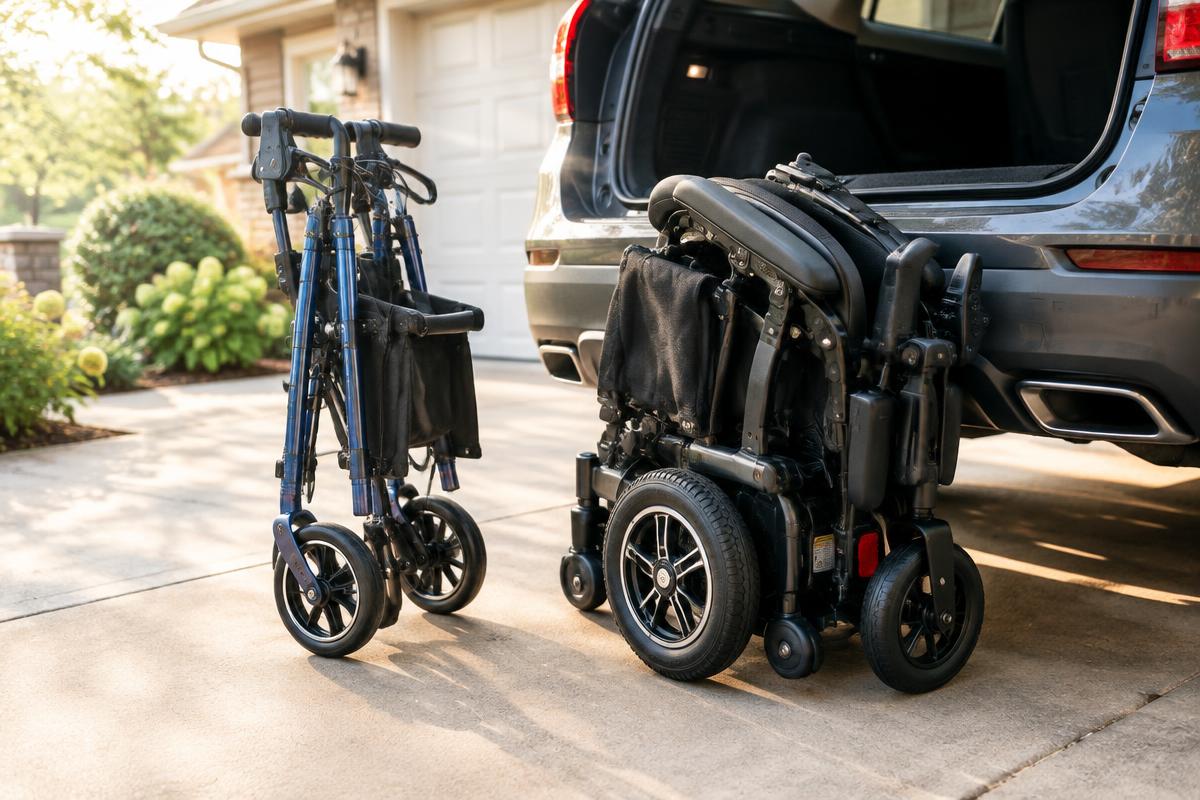
The lift that actually happens
A trunk lift is not a clean deadlift. You are bending forward over a bumper, holding an awkward object away from your body, at chest height, often on a slope, in a parking lot, possibly in the rain. Physically, lifting a 40 lb object at arm's length loads your back like a much heavier object held close.
That's why the honest question isn't "can you lift 50 pounds once?" It's "can you lift it twice a day, on the day your shoulder hurts, without help?"
Typical weights, by category
| Equipment | Typical weight | Loading it into a car |
|---|---|---|
| Cane | under 2 lbs | Anyone |
| Standard walker | 5 – 7 lbs | Anyone |
| Rollator with seat | 15 – 22 lbs | Most people can load it |
| Manual transport chair | 18 – 30 lbs | Most people can load it |
| Light folding power chair | 29 – 40 lbs | Many can, one-handed lift at the frame |
| Standard folding power chair | 50 – 70 lbs | Two people, or a hoist |
| Mobility scooter (disassembled) | 25 – 40 lbs per piece | Multiple trips to the car |
| Full-size power chair | 150 lbs+ | Vehicle lift or ramp required |
Ranges reflect what's widely sold today; individual models vary.
Test it before you buy it
You don't need the chair to run this test. You need a box and a bathroom scale.
The driveway test, at home, in five minutes
- Load a sturdy box to the chair's advertised weight — include the batteries.
- Set it on the ground behind your car, arm's length from the bumper.
- Lift it into the trunk the way you actually would. Then take it out again.
- Do it three times, with a minute between. Note your back, your grip and your balance.
- Repeat tomorrow. If day two is worse, that chair is too heavy for daily use.
If you can't do three round trips comfortably, subtract 10 pounds and look again. Nobody regrets a chair that's easier to load.
What the weight is made of
Frame material sets the floor. Steel is cheap and heavy. Aluminum is the common middle. Carbon fiber is stronger than steel per pound and takes a folding power chair down into the high twenties — a class that didn't exist a few years ago.
Batteries are the other half of the number. Two small lithium packs are lighter than one big sealed lead-acid battery, and they also come out of the frame, so you can lift the chair and the batteries separately. Always check whether the advertised weight includes batteries: "29 lbs" and "29 lbs plus batteries" are different chairs.
When heavier is the right answer
Weight isn't the only spec, and lighter isn't automatically better. Choose a heavier chair when it never leaves the house, when someone else always loads it, when you have a van with a ramp or lift, or when you need full-size seating, tilt, recline or serious outdoor suspension. Those features have mass and the mass is doing something.
A quick rule of thumb
- Loaded by the user alone, daily: aim under 35 lbs, ideally with removable batteries.
- Loaded by a spouse of similar age: under 35 lbs, or buy a ramp.
- Loaded by a younger caregiver: up to about 50 lbs is workable.
- Never loaded into a car: weight barely matters — buy on seating and range.
- Flying more than once a year: under 35 lbs with batteries under 300Wh each.
Bottom line
Range, speed and seat colors are the specs people shop on. Weight is the spec that decides usage. The best chair is the one that gets into the car.
General information, not medical advice. A physical or occupational therapist can assess safe lifting limits and the right seating for a specific person.